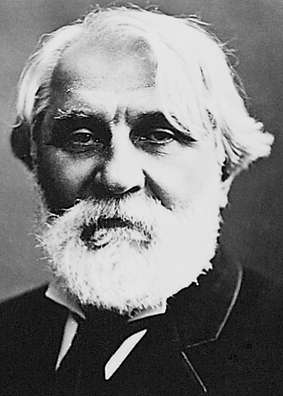
In between Kierkegaard and Dostoevsky in our "Existentialist primer" is a small three-page excerpt from 19th century Russian novelist Ivan Turgenev's Fathers and Sons that seems especially relevant given the conversation at the end of class this afternoon. This segment in particular speaks to our questioning whether or not, if prompted, each individual human being would chose to act against his/her being boxed into becoming a predictable, logarithmic, "piano key," so to speak, and whether it is the case that every single person would make this decision (what if someone choose to live in the Matrix?):
"He is a nihilist," Arkady repleated.
"A nihilist," Nikolai Petrovich said. "That's from the Latin nihil--nothing, as far as I can judge. Does that mean a person who believes in nothing?"
"Say, 'Who respects nothing,'" put in Pavel Petrovich, applying himself to the butter again.
"Who regards everything critically," Arkady observed.
"Isn't that the same thing?" asked Pavel Petrovich.
"No, it isn't. A nihilist is a person who does not look up to any authorities, who does not accept a single principle on faith, no matter how highly that principle may be esteemed."
"Well, and is that a good thing?" Pavel Petrovich broke in.
"It all depends, Uncle. It may be good for some people and very bad for others."
"I see. Well, this, I see, is not in our line. We are men of the old school--we believe that without principles...taken on faith one cannot stir a step or draw a breath...We shall see how you manage to live in a void, in a vacuum."
Though Turgenev here is discussing nihilism and not necessarily existentialism, per se, the two terms seem to be interchangeable in this context. My question, then, is to what extent nihilism and existentialism are (a) similar, and (b) separate philosophies. From what background I have in these these two areas I am inclined to consider existentialism as the more optimistic ("the most optimistic," Sartre would argue) philosophy, and yet, from what we see here in Fathers and Sons I find it difficult to see considerable distinction between nihilism and existentialism in terms of their respective views on the individual and his/her ability (obligation?) to make meaning for him/herself.
Clearly there is a difference between the two (or else there would be no need to have to names for the same school of thought), but what is the difference? And is this difference significant?


4 comments:
I feel like nihilism asserts that life has no intrinsic meaning or value, while existentialists actively search, on an individual basis, for that which gives their own lives meaning and value.
You'll have to forgive me for checking Wikipedia on this one, but there is an interesting section in the entry for nihilism that concerns Nietche's direct opposition to the doctrine. I rather liked the directness of this quote:
"A nihilist is a man who judges of the world as it is that it ought NOT to be, and of the world as it ought to be that it does not exist. According to this view, our existence (action, suffering, willing, feeling) has no meaning: the pathos of 'in vain' is the nihilists' pathos — at the same time, as pathos, an inconsistency on the part of the nihilists." (The Will to Power, section 585, translated by Walter Kaufmann)
I feel like what Nietzche's getting at is that Existentialism is examining and embracing our very existence. Existentialists attempt to give themselves meaning, while nihilists see no point in doing so.
It seems to me that your quote from Turgenev depicts nihilists as skeptics more than anything. I think that classical nihilists take skepticism one step further into denial.
On this point, Mark is-- at least partially-- right. "Nihilists" do not believe in objective values, including moral values. That is, nihilists believe that nothing has an intrinsic or essential value in and of itself. Like most philosophical positions, there are "varieties" of nihilism (some of which are very close to the core strains of existentialism, some of which are further away)... but it would be a bit of a stretch to say that existentialism and nihilism were synonymous.
For those interested in the relationship between existentialism and nihilism, you might want to take a look at this, which is an equally cursory, but slightly more legitimate, source.
As we will see very soon, Nietzsche had an extremely nuanced and complicated relationship with nihilism. Or, at least, he had as nuanced and complicated a relationship as one can have with "nothing"!
Very nice post, though, MJG!
Get ready to be depressed (not really). Basically what I know of Nihilism is that the world, as it stands, has no objective value, and is ultimately meaningless and empty. This is where Existentialism (sort of) overlaps. Existentialism is more a believe that existence precedes essence, that people make values and meaning in the world and have shaped and evolved those values over time.
Post a Comment