It’s taken me awhile to put this on here, but I’m going to attempt to articulate an objection to Nietzsche’s concept of the sickness of the slave morality. From what I understand, human values were first objectively determined by the strong and the powerful with which a system of evaluation developed where morality is based on the life affirming principle of predator versus prey.
The masses then become tired of being the weak, the bad, the impoverished, the slaves and begin to resent their life and develop their own point of view in which the blessed are the weak and the strong are the sinners. This morality is based, according to Nietzsche, on resentment and is considered a ‘slave morality’. This slave morality is founded within the church that blesses the weak as defined through Jesus Christ. Nietzsche then goes on to describe that this value system is sick and a sign of weakness of the human spirit and ultimately denies the true nature of the powerful and the weak.
Maybe I have read too much Marx for my own good; however, let’s examine from the point when slaves began to resent their life. Obviously, this becomes a threat to the powerful as the so called weak are many more in number. According to Marx, it was this point that the church was created by the powerful, the morality in which the weak are the blessed and will ultimately go to heaven. In this sense, the church was created by the powerful in order to pacify the masses and their increasing restlessness. As such, one could argue that the idea of a ‘slave morality’ is a concept invented by the powerful in order to remain control over the masses and thus is a continuation of the natural world in which the powerful prevail and the weak are oppressed.
In this case, I would certainly not consider the hoipolloi weak and sick in any manner because they are not conscious of their position in the natural society as the church and the ‘slave morality’ has put a blanket over their eyes. They are operating in the elite induced perspective of “suffer in this world for an eternal heaven in the next”. However, I would like to add that there does exist the SICK – those that are conscious of this situation yet continue to allow themselves to be oppressed.
Also, I believe a distinction between the conscious and the unconscious is an important one to note and maybe worth discussing in class.
Friday, September 26, 2008

"Contemporary Liberalism and the Problem of Racism" by Dr. Howard McGary
 Dr. Howard McGary of Rutgers University kicked off this year's Spindel Conference at the University of Memphis' Fogelman Executive Center. The title of this year's conference being Race, Racism, and Liberalism in the 21st Century, Dr. McGary gave a lecture that sought to define what exactly "liberalism" is and to explain its shortcomings both historically and currently in dealing with the issue of race and racism. His lecture, entitled "Contemporary Liberalism and the Problem of Racism", began by defining 'classical liberalism' in the Lockean sense that personal liberty and autonomy are the highest of moral values and that all persons are moral equals. He went on further to define 'contemporary liberalism' as the notion that the state has a moral responsibility in ensuring the equality of results for all its citizens.
The problem with contemporary liberalism, according to Dr. McGary, is that it tends to misconstrue the attitude of race. This is because there is much debate and disagreement regarding whether or not race may appropriately be used in making moral judgements (e.g. "blacks should not kill blacks"). The reason for disagreement on this subject is the notion that moral judgements ought to be universal, and a moral judgement that uses race as a factor is anything but universal. Furthermore, race is a biological factor that humans have no control over, thus rendering it a morally irrelevant criteria for making a moral judgement. Dr. McGary here offers his objection to this argument. According to McGary, it is imperative that race be defined in social and/or historical terms, rather than biologically. Thus the question "Was American slavery wrong because blacks were enslaved or because human beings were enslaved?" is one that may be justifiably answered in terms of race. For, according to Dr. McGary, human oppression and black oppression are completely different notions and must be addressed as such. The blanket term "human oppression" is not nearly sufficient in describing the specific types of pain and anguish that blacks in America have been the victim of since the country's founding. Thus, race is relevant (indeed, is imperative) in sufficiently describing human experience and making corresponding moral judgements.
Finally, Dr. McGary addressed the fact that the philosophical canon tends to be greatly lacking in the topics of race and racism. This is mostly due to the fact that many view this subject area as failing to meet the criteria to qualify as a legitimate philosophic topic. Contemporary liberalism tends to push the subject as racism as strictly being a question that is better-suited for sociologists and psychologists rather than philosophers. Even in the case when the topic's philosophical status is granted, is is often pushed off to the side and designated as "applied philosophy". According to Dr. McGary, race's recognition as a legitimate philosophical branch is of the utmost importance if the appropriate societal changes are to be instated. He emphasized the notion that, to achieve this, contemporary liberalism must address the negative cultural images of blacks in America and beyond (e.g. lazy, welfare-addicted, etc.) as well as the fact that institutionalized racism is a problem that extends far beyond specific individuals. He ends with stating his hope that an alternative theory to contemporary liberalism may be posited - one that sufficiently addresses the issues of race and racism.
Thursday, September 25, 2008
Comments on Notes From the Underground.
Although it has been almost two weeks since we discussed the thoughts and works of Feodor Dostoyevsky in class, I still find the ideas which he presented in Notes From the Underground to be my favorite batch of existential thoughts discussed thus far. I find a great deal of truth in his theory that man will do whatever it takes to avoid being thought of as an object or an organism behaving formulaically. Dostoyevsky firmly states his belief that the most imortant thing to humans, often outweighing even the desire for survival, is the desire to be free and to excercise our free will. Within Notes From the Underground he writes, "for what is a man without desire, without free will and without choice, if not a stop in an organ."
It seems to me that examples of this thought process and this desire of man to excercise free will, even unrationally at times, are displayed regularly in modern society. In class last week, I brought up the subject of extreme human behaviors such as rock climbing and skydiving. To me, these are perfect examples of humans rejecting what is rational in an effort to feel free and non-formulaic in nature. Activities like these are obviously not contributing to our well being, in fact, they often put us at great risk of dying or becoming seriously injured. However, humans still participate in these activities regularly, and often pay large sums of money to do so! What is rational about this type of behavior? It appears that humans participate in activities such as this to satisfy a need. In Notes From the Underground, Dostoyevsky speaks through the character of a diseased man who refuses to seek medical attention when it could most likely save his life. The man claims, "I know better than anyone else that I thereby injure only myself and no one else. But still, if I don't treat it, it is out of spite. My liver is bad, well then let it get worse!" Again, althought this type of behavior seems ridiculous, we can find examples of similar behavior all throughout human history. Most people know the story of Chris McCandless, the young man who, after graduating from Emory University, gave all of his money to charity and proceeded to live a life of complete randomness, travelling around the United States, living on almost nothing before finally starving to death in the Alaskan wilderness. At anytime McCandless could have turned back and gone home to his wealthy family who could have provided him with all of the creature comforts man might want. He didn't though. Again, this type of behavior is anything but rational. However, people are drawn to stories like this. McCandless' story was published as a book and eventually made into a movie while being hailed as the "ultimate quest for freedom" and a story that "will touch audiences deeply". Why is it that we are drawn to irrational behavior such as this. Chris McCandless, in all his irrationality, has attracted swarms of followers who praise him and the things which he did. "Pilgrimages" are frequently made to his gravesite as people pay homage to someone whom they now consider a hero.
Although many of us will never abandon our belongings and take off into the wild, we tend to all have our own instances of rebelion against the ordinary grind of everyday life. We all seem to do things that are irrational at times just to escape the monotony. Dostoyevsky states, "there is one case, one only, when man may purposely, consciously, desire what is injurious to himself, what is stupid, very stupid-simply in order to have the right to desire for himself even what is very stupid and not to be bound by an obligation to desire only what is rational." I think this sums up human nature very clearly and concisely. What seems to make us different from every other living organism on earth is that we perform the action of choosing. We do not simply react to stimuli, we experience the stimuli and then choose how we will react and very often, the decision we make is not the most beneficial to our existence on this planet.
It seems to me that examples of this thought process and this desire of man to excercise free will, even unrationally at times, are displayed regularly in modern society. In class last week, I brought up the subject of extreme human behaviors such as rock climbing and skydiving. To me, these are perfect examples of humans rejecting what is rational in an effort to feel free and non-formulaic in nature. Activities like these are obviously not contributing to our well being, in fact, they often put us at great risk of dying or becoming seriously injured. However, humans still participate in these activities regularly, and often pay large sums of money to do so! What is rational about this type of behavior? It appears that humans participate in activities such as this to satisfy a need. In Notes From the Underground, Dostoyevsky speaks through the character of a diseased man who refuses to seek medical attention when it could most likely save his life. The man claims, "I know better than anyone else that I thereby injure only myself and no one else. But still, if I don't treat it, it is out of spite. My liver is bad, well then let it get worse!" Again, althought this type of behavior seems ridiculous, we can find examples of similar behavior all throughout human history. Most people know the story of Chris McCandless, the young man who, after graduating from Emory University, gave all of his money to charity and proceeded to live a life of complete randomness, travelling around the United States, living on almost nothing before finally starving to death in the Alaskan wilderness. At anytime McCandless could have turned back and gone home to his wealthy family who could have provided him with all of the creature comforts man might want. He didn't though. Again, this type of behavior is anything but rational. However, people are drawn to stories like this. McCandless' story was published as a book and eventually made into a movie while being hailed as the "ultimate quest for freedom" and a story that "will touch audiences deeply". Why is it that we are drawn to irrational behavior such as this. Chris McCandless, in all his irrationality, has attracted swarms of followers who praise him and the things which he did. "Pilgrimages" are frequently made to his gravesite as people pay homage to someone whom they now consider a hero.
Although many of us will never abandon our belongings and take off into the wild, we tend to all have our own instances of rebelion against the ordinary grind of everyday life. We all seem to do things that are irrational at times just to escape the monotony. Dostoyevsky states, "there is one case, one only, when man may purposely, consciously, desire what is injurious to himself, what is stupid, very stupid-simply in order to have the right to desire for himself even what is very stupid and not to be bound by an obligation to desire only what is rational." I think this sums up human nature very clearly and concisely. What seems to make us different from every other living organism on earth is that we perform the action of choosing. We do not simply react to stimuli, we experience the stimuli and then choose how we will react and very often, the decision we make is not the most beneficial to our existence on this planet.
Wednesday, September 24, 2008
Das Übermensch: defining an ideal
I am incredibly interested in Nietzsche's idea of the übermensch (which I'm going to refer to without the umlaut or italics from here on because that gets annoying), this sort of ideal being of power that comes into play in his work, in particular Thus Spoke Zarathustra, which we haven't read in class. Because we've spent a good bit of class time asking questions about what Nietzsche's really getting at with this idea, I'd like to examine it here and maybe come up with a working model of it so we've got something to go on. In his introduction to our book's section on Nietzsche, Solomon gives us a sort of capsule-sized view of the ubermensch:
This is Solomon saying pretty much exactly what I just said before, so not much help there. So maybe the best way for us to get a clearer picture of what Nietzsche's talking about, we should start with what we know and then follow that up in the comments with what we're still confused about, or issues that arise.
One of Nietzsche's most famous ideas is his fantasy of an 'Übermensch'—a more than 'human-all-too-human' being who is to serve as our new ideal. But this idea, too, is rather sketchy and limited to a single book, the prologue of Nietzsche's pseudo-biblical epic, Thus Spoke Zarathustra. (p. 66)
This is Solomon saying pretty much exactly what I just said before, so not much help there. So maybe the best way for us to get a clearer picture of what Nietzsche's talking about, we should start with what we know and then follow that up in the comments with what we're still confused about, or issues that arise.
So far, here's what I know about the ubermensch:
The ubermensch is a living embodiment of Nietzsche's life-affirming philosophy. His (yes, his, not her) consciousness and actions are rooted in "master" or life-affirming principles. As such, he creates values rather than follows them. This leads to an interesting conundrum for Nietzsche's readers; by reading or following the philosophy that Nietzsche outlines, we no longer create our own values, instead following ideas set out by someone else. This is part of the "slave morality" that Nietzsche so steadfastly rails against in Beyond Good and Evil (which we did read from). At this point slave morality is primarily derived from religion, specifically Judeo-Christian doctrine. To Nietzsche, this doctrine is based in ressentiment, which is essentially a deep-seated form of resentment or hatred toward true power. This is best depicted in the beattitudes:
3Blessed are the poor in spirit,
for theirs is the kingdom of heaven.
4Blessed are those who mourn,
for they will be comforted.
5Blessed are the meek,
for they will inherit the earth.
6Blessed are those who hunger and thirst for righteousness,
for they will be filled.
7Blessed are the merciful,
for they will be shown mercy.
8Blessed are the pure in heart,
for they will see God.
9Blessed are the peacemakers,
for they will be called sons of God.
10Blessed are those who are persecuted because of righteousness,
for theirs is the kingdom of heaven.11Blessed are you when people insult you, persecute you and falsely say all kinds of evil against you because of me. 12Rejoice and be glad, because great is your reward in heaven, for in the same way they persecuted the prophets who were before you.
This doctrine runs completely counter to Nietzsche's argument for life-affirmation; rather than embrace life as it is on earth, religions like this look toward the afterlife for fulfillment.
So from this we get the idea that Nietzsche isn't giving us a prescriptive philosophy—that is, he's not telling us how we should act. Instead, he's focusing on what he believes will happen. Someday humans as they are (weak, slavish beings) will die off and a race of ubermenschen will arise. This group will have no reason to read Nietzsche; therefore, these writings are meant to explain what's going to happen and why we should accept—or even embrace—it. We should be happy that the world will become the domain of the strong.
I'll end with a few quotes from Thus Spoke Zarathustra that give a good view of this ideal:
And Zarathustra spoke thus to the people:"I teach you the overman. Man is something that shall be overcome."Behold, I teach you the overman. The overman is the meaning of the earth. Let your will say: the overman shall be the meaning of the earth! I beseech you, my brothers, remain faithful to the earth, and do not believe those who speak to you of otherworldy hopes! Poison-mixers are they, whether they know it or not. Despisers of life are they, decaying and poisoned themselves, of whom the earth is weary: so let them go.Once the sin against God was the greatest sin; but God died, and these sinners died with him. To sin against the earth is now the most dreadful thing, and to esteem the entrails of the unknowable higher than the meaning of the earth.
Monday, September 22, 2008
2008 Spindel Philosophy Conference
This coming weekend is the annual Spindel Philosophy Conference at the University of Memphis. This year's theme is "Race, Racism and Liberalism in the 21st Century." Speakers include some of the best philosophers working in race theory and political theory today, including Linda Martin Alcoff (Syracuse University), Bernard Boxill (University of North Carolina), Kathryn Gines (Vanderbilt University), Howard McGary (Rutgers), Charles Mills (Northwestern), Paul Taylor (Temple), and Naomi Zack (University of Oregon).
The Spindel Conference runs from Thursday evening (Sep. 25) through the end of the day on Saturday (Sep. 27). A full schedule for the conference can be accessed here. All sessions will be held in the Fogleman Executive Center on the campus of the University of Memphis. You can access a campus map here.
The Spindel Conference runs from Thursday evening (Sep. 25) through the end of the day on Saturday (Sep. 27). A full schedule for the conference can be accessed here. All sessions will be held in the Fogleman Executive Center on the campus of the University of Memphis. You can access a campus map here.
Saturday, September 13, 2008
Dostoevsky: Too Romantic for My Taste
At the end of class on Thursday, I had trouble determining how the gas station attendant in the clip from No Country for Old Men fit into the Dostoevsky’s conception of man as inherently disinclined to have his freedom taken away. The Underground Man says, “The whole work of man seems really to consist in nothing but proving to himself continually that he is a man and not an organ stop” (Solomon 47). In other words, man’s inclination is to do whatever it takes to demonstrate that he cannot be reduced to some functional explanation, but rather is unpredictable and free. Even if we proved that human behavior could be reduced to a mathematical equation, man would “devise destruction and chaos, devise sufferings of all sorts, and [would] thereby have his own way” (47). And yet, in embracing a formulaic, calculable lifestyle, the gas station attendant behaves in a way that stands in stark contrast to Dostoevsky’s description of human nature. Presumably, day in and day out, the gas station attendant wakes up in the morning, opens the store, serves his customers, closes at dark, and goes to sleep. His life can be reduced to nothing more than this - an algorithm that is comfortable but absolutely meaningless. In other words, he is, and more importantly, seems inclined to be, nothing more than an organ stop. After all, he married into it.
Here we see Cypher deliberately trading his freedom from the machine world for the Matrix, and in doing so, implicitly accepting that he is reducible to nothing more than a mere battery. He thus chooses meaninglessness instead of freedom and offers another clear counterexample to what the Underground Man argues is inherent in human nature.
As far as I can tell, scenarios like this are not unusual. I suspect we all know people, and in many ways are people, who live a routine, formulaic lifestyle and wouldn’t have it any other way. This sort of behavior is nicely conveyed by the character Cypher in The Matrix. For anyone unfamiliar with the movie, it’s about the world in which humans naively assume they exist. The catch is that none of it’s real. Instead, the actual world has been taken over by an army of artificially intelligent beings who have plugged the human race into what’s known as “The Matrix” or a computer generated world that looks just like the one we see around us. Then, while the humans are plugged into cyber space, the artificially intelligent beings use their bodies for energy. A few humans, including Cypher, escape the Matrix and try to take down the machines as a means to free humanity. However, Cypher the traitor in the group, turns against them in favor of returning to the imaginary world. The following scene depicts Cypher making a deal with the agents in charge of the Matrix that will allow him to return.
Here we see Cypher deliberately trading his freedom from the machine world for the Matrix, and in doing so, implicitly accepting that he is reducible to nothing more than a mere battery. He thus chooses meaninglessness instead of freedom and offers another clear counterexample to what the Underground Man argues is inherent in human nature.
To me, this suggests that Dostoevsky has offered an overly glorified and romantic assessment of humanity. In light of the examples above and our experience with human beings in general, I’d say we are very much inclined to be piano keys and organ stops. On rare occasion, a human might reject this and do something nutty to prove he has some semblance of control over his life. However, more often than not, we simply slide into what’s comfortable and exist that way until we die, despite how reducible that makes us. If humans did routinely commit acts of capriciousness as a means to assert their freedom and the meaningfulness of their lives, we would no doubt be a wonderful and unique species. However, as it stands, I remain unconvinced that it is in any way inherent in us to transcend our formulaic lifestyles. Instead, I think that we are greatly inclined to do just the opposite, making us far less remarkable than Dostoevsky suggests.
Thursday, September 11, 2008
The Illusion of Choice: Kiekegaard and Dostoevsky from a Zizekian Prospective
“Objectivity emphasizes: what is said; subjectivity: how it is said.” -Soren Kierkegaard
Kierkegaard does not deny the existence of an absolute truth, only suggests that we cannot ever reach it objectively. In thinking about absolute truth, Plato’s forms come to mind—the idea that there is some absolute, conclusive definition of love or truth or any other abstraction floating around in the cosmos, seems sort of silly, but is that really what we mean by “truth”? What do we mean? We can argue all day long about the semantics of the issue, but Kierkegaard skips over the question of the absolute, because to him, it is of much less importance. There might be absolute Truth, but we’ll never know it, or at least, we will never be able to prove it exists. The way each of us perceives reality is too individual, too subjective, always colored through the lens of our upbringing, cultural norms, social conditioning, etc. For Kierkegaard (and Dostoevsky), “only in subjectivity is their decision” because objectivity is certain knowledge, while decisions are based in uncertainty.
I recently watched a documentary on the Lacanian-Marxist philosopher Slovaj Zizek titled Zizek!. He has some interesting things to say about philosophy’s role, specifically in relation to this question of absolute Truth. Below is a clip from the documentary in which he addresses this (pay particular attention to 00:26-03:22) as well as a brief mention of Lacan’s reversal of Dostoevsky’s well-known tenet, “If God does not exist, then everything is permitted” (03:22-07:20).
Slovaj Zizek argues that philosophy is not concerned with the question of truth, “the question is, ‘what do you mean when you say this is true?’” Sound familiar? To paraphrase Kierkegaard: what is important is not what you say but how you say it. Truth, as well as meaning, is rooted in individual experience. As we’ve already discussed in class, we create meaning for ourselves, whether we are conscious of it or not. Zizek argues that though we live in a “free” society, where enjoyment is not prohibited, in reality, our enjoyment is prohibited because of our (subconscious) guilt.
Considering we are reading Nietzsche next, I found this excerpt from Zizek’s “How to Read Lacan” particularly pertinent:
“The modern atheist thinks he knows that God is dead; what he doesn't know is that, unconsciously, he continues to believe in God. What characterizes modernity is no longer the standard figure of the believer who secretly harbors intimate doubts about his belief and engages in transgressive fantasies; today, we have, on the contrary, a subject who presents himself as a tolerant hedonist dedicated to the pursuit of happiness, and whose unconscious is the site of prohibitions: what is repressed are not illicit desires or pleasures, but prohibitions themselves. "If God doesn't exist, then everything is prohibited" means that the more you perceive yourself as an atheist, the more your unconscious is dominated by prohibitions which sabotage your enjoyment. (One should not forget to supplement this thesis with its opposite: if God exists, then everything is permitted - is this not the most succinct definition of the religious fundamentalist's predicament? For him, God fully exists, he perceives himself as His instrument, which is why he can do whatever he wants, his acts are in advance redeemed, since they express the divine will...)
Instead of bringing freedom, the fall of the oppressive authority thus gives rise to new and more severe prohibitions. How are we to account for this paradox? Think of the situation known to most of us from our youth: the unfortunate child who, on Sunday afternoon, has to visit his grandmother instead of being allowed to play with friends. The old-fashioned authoritarian father's message to the reluctant boy would have been: "I don't care how you feel. Just do your duty, go to grandmother and behave there properly!" In this case, the child's predicament is not bad at all: although forced to do something he clearly doesn't want to, he will retain his inner freedom and the ability to (later) rebel against the paternal authority. Much more tricky would have been the message of a "postmodern" non-authoritarian father: "You know how much your grandmother loves you! But, nonetheless, I do not want to force you to visit her - go there only if you really want to!" Every child who is not stupid (and as a rule they are definitely not stupid) will immediately recognize the trap of this permissive attitude: beneath the appearance of a free choice there is an even more oppressive demand than the one formulated by the traditional authoritarian father, namely an implicit injunction not only to visit the grandmother, but to do it voluntarily, out of the child's own free will. Such a false free choice is the obscene superego injunction: it deprives the child even of his inner freedom, ordering him not only what to do, but what to want to do.”
By reducing our choices, desires, impulses, etc., to mere psychoanalytic categories (i.e., the superego injunction), is Zizek committing the same crime as the scientific/naturalist reductionists whom Dostoevsky is condemning for reducing us to algorithms? According to Dostoevsky, humankind will always chose to exercise free will, to make a choice, even if that choice is irrational. But what if that choice, is only the illusion of a choice? That is, by making a choice in which you think you are exerting your individuality and independence, you are actually perpetuating power relations within the system. Does it matter? Is there a way to take the red pill and escape the matrix, if our very desires and choices are artificial? Cheesy pop-culture references aside, another way to pose the question is this: are our choices legitimate if we cannot separate them from those things that externally or internally inform our choices? Does it even matter that the individuality we exert in free will is derived from these modes of control? Is it then, still individuality? Is there any way to escape that control?
Kierkegaard does not deny the existence of an absolute truth, only suggests that we cannot ever reach it objectively. In thinking about absolute truth, Plato’s forms come to mind—the idea that there is some absolute, conclusive definition of love or truth or any other abstraction floating around in the cosmos, seems sort of silly, but is that really what we mean by “truth”? What do we mean? We can argue all day long about the semantics of the issue, but Kierkegaard skips over the question of the absolute, because to him, it is of much less importance. There might be absolute Truth, but we’ll never know it, or at least, we will never be able to prove it exists. The way each of us perceives reality is too individual, too subjective, always colored through the lens of our upbringing, cultural norms, social conditioning, etc. For Kierkegaard (and Dostoevsky), “only in subjectivity is their decision” because objectivity is certain knowledge, while decisions are based in uncertainty.
I recently watched a documentary on the Lacanian-Marxist philosopher Slovaj Zizek titled Zizek!. He has some interesting things to say about philosophy’s role, specifically in relation to this question of absolute Truth. Below is a clip from the documentary in which he addresses this (pay particular attention to 00:26-03:22) as well as a brief mention of Lacan’s reversal of Dostoevsky’s well-known tenet, “If God does not exist, then everything is permitted” (03:22-07:20).
Slovaj Zizek argues that philosophy is not concerned with the question of truth, “the question is, ‘what do you mean when you say this is true?’” Sound familiar? To paraphrase Kierkegaard: what is important is not what you say but how you say it. Truth, as well as meaning, is rooted in individual experience. As we’ve already discussed in class, we create meaning for ourselves, whether we are conscious of it or not. Zizek argues that though we live in a “free” society, where enjoyment is not prohibited, in reality, our enjoyment is prohibited because of our (subconscious) guilt.
Considering we are reading Nietzsche next, I found this excerpt from Zizek’s “How to Read Lacan” particularly pertinent:
“The modern atheist thinks he knows that God is dead; what he doesn't know is that, unconsciously, he continues to believe in God. What characterizes modernity is no longer the standard figure of the believer who secretly harbors intimate doubts about his belief and engages in transgressive fantasies; today, we have, on the contrary, a subject who presents himself as a tolerant hedonist dedicated to the pursuit of happiness, and whose unconscious is the site of prohibitions: what is repressed are not illicit desires or pleasures, but prohibitions themselves. "If God doesn't exist, then everything is prohibited" means that the more you perceive yourself as an atheist, the more your unconscious is dominated by prohibitions which sabotage your enjoyment. (One should not forget to supplement this thesis with its opposite: if God exists, then everything is permitted - is this not the most succinct definition of the religious fundamentalist's predicament? For him, God fully exists, he perceives himself as His instrument, which is why he can do whatever he wants, his acts are in advance redeemed, since they express the divine will...)
Instead of bringing freedom, the fall of the oppressive authority thus gives rise to new and more severe prohibitions. How are we to account for this paradox? Think of the situation known to most of us from our youth: the unfortunate child who, on Sunday afternoon, has to visit his grandmother instead of being allowed to play with friends. The old-fashioned authoritarian father's message to the reluctant boy would have been: "I don't care how you feel. Just do your duty, go to grandmother and behave there properly!" In this case, the child's predicament is not bad at all: although forced to do something he clearly doesn't want to, he will retain his inner freedom and the ability to (later) rebel against the paternal authority. Much more tricky would have been the message of a "postmodern" non-authoritarian father: "You know how much your grandmother loves you! But, nonetheless, I do not want to force you to visit her - go there only if you really want to!" Every child who is not stupid (and as a rule they are definitely not stupid) will immediately recognize the trap of this permissive attitude: beneath the appearance of a free choice there is an even more oppressive demand than the one formulated by the traditional authoritarian father, namely an implicit injunction not only to visit the grandmother, but to do it voluntarily, out of the child's own free will. Such a false free choice is the obscene superego injunction: it deprives the child even of his inner freedom, ordering him not only what to do, but what to want to do.”
By reducing our choices, desires, impulses, etc., to mere psychoanalytic categories (i.e., the superego injunction), is Zizek committing the same crime as the scientific/naturalist reductionists whom Dostoevsky is condemning for reducing us to algorithms? According to Dostoevsky, humankind will always chose to exercise free will, to make a choice, even if that choice is irrational. But what if that choice, is only the illusion of a choice? That is, by making a choice in which you think you are exerting your individuality and independence, you are actually perpetuating power relations within the system. Does it matter? Is there a way to take the red pill and escape the matrix, if our very desires and choices are artificial? Cheesy pop-culture references aside, another way to pose the question is this: are our choices legitimate if we cannot separate them from those things that externally or internally inform our choices? Does it even matter that the individuality we exert in free will is derived from these modes of control? Is it then, still individuality? Is there any way to escape that control?
*Disclaimer* Most of the time, I have no idea what I actually think, so don't take this too seriously.
Existentianihilism:
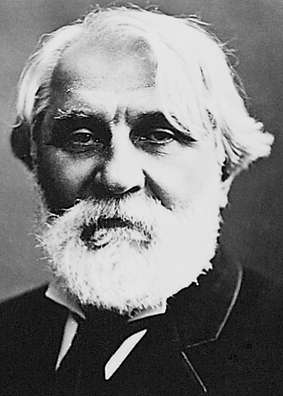
In between Kierkegaard and Dostoevsky in our "Existentialist primer" is a small three-page excerpt from 19th century Russian novelist Ivan Turgenev's Fathers and Sons that seems especially relevant given the conversation at the end of class this afternoon. This segment in particular speaks to our questioning whether or not, if prompted, each individual human being would chose to act against his/her being boxed into becoming a predictable, logarithmic, "piano key," so to speak, and whether it is the case that every single person would make this decision (what if someone choose to live in the Matrix?):
"He is a nihilist," Arkady repleated.
"A nihilist," Nikolai Petrovich said. "That's from the Latin nihil--nothing, as far as I can judge. Does that mean a person who believes in nothing?"
"Say, 'Who respects nothing,'" put in Pavel Petrovich, applying himself to the butter again.
"Who regards everything critically," Arkady observed.
"Isn't that the same thing?" asked Pavel Petrovich.
"No, it isn't. A nihilist is a person who does not look up to any authorities, who does not accept a single principle on faith, no matter how highly that principle may be esteemed."
"Well, and is that a good thing?" Pavel Petrovich broke in.
"It all depends, Uncle. It may be good for some people and very bad for others."
"I see. Well, this, I see, is not in our line. We are men of the old school--we believe that without principles...taken on faith one cannot stir a step or draw a breath...We shall see how you manage to live in a void, in a vacuum."
Though Turgenev here is discussing nihilism and not necessarily existentialism, per se, the two terms seem to be interchangeable in this context. My question, then, is to what extent nihilism and existentialism are (a) similar, and (b) separate philosophies. From what background I have in these these two areas I am inclined to consider existentialism as the more optimistic ("the most optimistic," Sartre would argue) philosophy, and yet, from what we see here in Fathers and Sons I find it difficult to see considerable distinction between nihilism and existentialism in terms of their respective views on the individual and his/her ability (obligation?) to make meaning for him/herself.
Clearly there is a difference between the two (or else there would be no need to have to names for the same school of thought), but what is the difference? And is this difference significant?
Calling the Coin
"What man needs is simply independent choice, whatever that independence may cost and wherever it may lead..."
--Fyodor Dostoevsky, Notes From Underground
Tuesday, September 9, 2008
Murderers And Madmen
There were definitely some leftover ideas from last Thursday’s class that dominated today’s discussion. Among these was a questioning of Abraham’s story as a true test of the paradox that is faith, which I found to be an interesting notion.
Abraham is just a man. In essence, he is no different than any other man. However, it is his faith that sets him apart from his peers. What is faith? Faith is, to use Kierkegaard’s terminology, an absolute relation to the absolute. That is to say, it is a direct relationship between a particular individual and God. The nature of this relationship is paradoxical, insofar as a single member of the universal sphere can somehow supersede that universe and be justified over the universal through his absolute relation to the absolute (God). Just how is it that Abraham’s faith is tested and he rises to become the template of true Christian faith?
Abraham and his wife Sarah, after being barren for decades and well past the age of childbirth, are finally given a son by God. One day, God casually tells Abraham to take his son up on Mt. Moriah, and sacrifice him as proof of his obedience to Him. Abraham does as he is commanded by the Lord, and he and Isaac go to Mt. Moriah together. Dutifully Abraham ties Isaac up on the altar, preparing him to be sacrificed, and once all is ready he unsheathes his dagger and prepares to sacrifice his son, his only son, the very same son that God promised so much would come from. It is in this moment that Abraham’s paradoxical situation comes to a climax. On the one hand, Abraham believes that Isaac will live to become the father of the Tribes of Israel (as God promised). He also is willing to sacrifice Isaac to God in order to show his obedience and do God’s will.
Abraham is in this moment, through his willingness to kill his son for a justification which he cannot explain to anyone else, superseding the sphere of the universal through faith. It is through this leap of faith that Abraham rises to become a knight of faith, who attains an absolute relation to the absolute. What sets him so far apart from other great people who have sacrificed for a higher power is that Abraham never resigns himself to the task of carrying out his duty, taking solace in the fact that it’s for God. Nor is he caught up in the absurdity of the paradox that he is faced with. Instead, Abraham steadfastly carries out God’s will, as if it were his own. To unflinchingly carry out the will of God, even if it costs you everything you’ve prayed for, and even if it may bring scorn and disdain to your name, that is what faith may require of you. For Kierkegaard, Faith is not something one proclaims, but something that a person must endure, in order to attain a direct, immediate relationship with God.
Subscribe to:
Posts (Atom)
